Payment tokenization replaces card data with a random token that has no value outside a specific transaction or merchant system.
Multi-use tokens make repeat payments convenient, while single-use tokens give the highest level of security.
Businesses can add tokenization through their payment provider to reduce the risk of stolen card data and simplify security requirements.
As digital payments continue to grow, payment fraud remains a significant concern. According to Alloy’s 2026 State of Fraud Report, 67% of surveyed financial institutions and fintechs reported an increase in fraud attempts in 2025, while 22% reported fraud losses exceeding $5 million.
Payment tokenization replaces sensitive payment data with random characters to protect transactions.
What is Tokenization in Payments?
Payment tokenization is the process of replacing sensitive payment data with a randomized string of characters—called a token—that holds no exploitable value outside a specific transaction or merchant system.
How Does Tokenization Work in Payments?
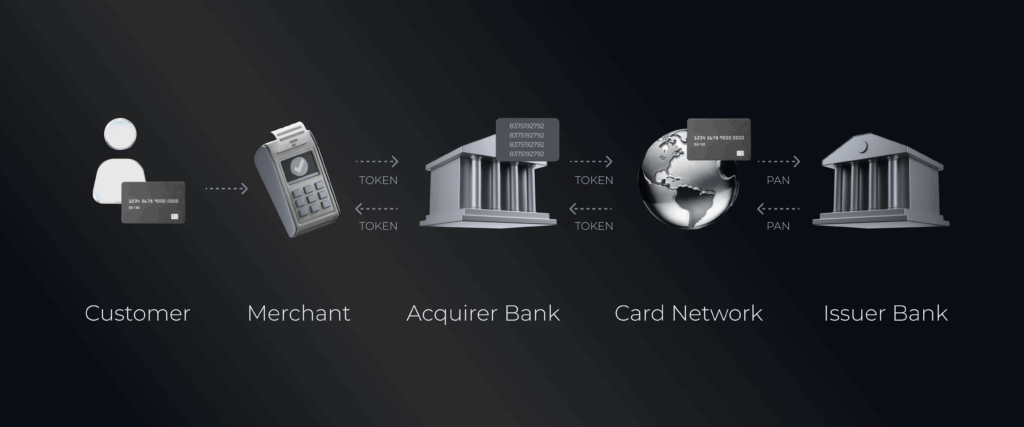
Tokenization replaces a primary account number with a surrogate value called a token. This token maps securely to the original card details without exposing sensitive data to merchants.
Example: Imagine you’re paying for coffee with your credit card.
Without tokenization:
Your real card number (e.g., 1234 5678 1234 5678) is sent to the payment processor.
Hackers can potentially intercept the data.
If stolen, your card could be used fraudulently.
With tokenization:
You tap your card or phone at the register.
Your bank or payment provider replaces your card number with a token, like “A1B2C3D4.”
The token is sent to the payment processor.
Behind the scenes, the payment provider maps the token to your real card number to complete the transaction.
If a hacker intercepts the token, it’s useless—only valid in that specific context.
Tokenization is like a coat check system. Your card number is your coat; the token is your coat check ticket. The ticket doesn’t resemble your coat, but it works within a specific environment—and once you retrieve your coat, the ticket is no longer valuable.
Single-use Tokens and Multi-Use Tokens
It may seem that all tokens are single-use, but multi-use tokens also exist.
Single-use tokens are valid for one transaction only and offer maximum security.
Multi-use tokens are reusable and provide greater convenience, especially for recurring payments, but come with slightly increased fraud risk since they’re easier to link back to the original card number.
Device-Based Tokenization and Online Tokenization
Tokens can be generated on a device or stored online:
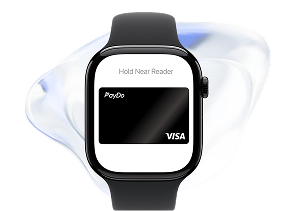
Device-based tokenization begins when you add your card to a digital wallet. The wallet contacts the payment network to tokenize your card, and your issuer may require authentication (e.g., OTP). Once approved, a token and cryptographic key are sent to your device for contactless payments.
Online tokenization is used when you save your card on a merchant’s website. The merchant requests a token through a token service provider. Once authenticated, the token is stored and updated as needed, enabling secure recurring payments—even if your card details change (e.g., expiration date).
Benefits of Payment Tokenization for Businesses
The key benefit of tokenization is enhanced security. Randomized tokens are nearly impossible to reverse-engineer within the time frame of a transaction, reducing the risk of data breaches. This means that tokenization keeps payment data safe with fewer resources, and can save businesses money on anti-fraud measures if they are willing to splurge on integrating the procedure into their systems.
Differences Between Tokenization and Encryption
Tokenization is not the only way to secure financial data by converting it into an unreadable format. Encryption is the other option: it uses cryptographic algorithms and keys that also make the process reversible.
Tokenization
Encryption
Purpose
Protects sensitive data by replacing it with a token
Secures data by converting it into unreadable format
Commonly used for protecting data in transit or at rest
Security Method
Substitution – stores original data in a secure vault
Mathematical transformation using cryptographic algorithms
Susceptibility to Attack
Tokens are useless without access to the vault
Encrypted data is unreadable, but could be brute-forced without strong keys
How to Implement Tokenization for Your Business?
Businesses can integrate tokenization through payment service providers and token requestors. PayDo provides reliable financial infrastructure with dedicated IBANs and clear onboarding within 3 to 5 business days.
Conclusion
Payment tokenization offers a powerful and creative way to protect financial data. While multi-use tokens improve convenience, single-use tokens provide the highest level of security. For businesses, tokenization is a scalable, cost-effective tool to reduce fraud risk and streamline compliance.
At PayDo, we prioritize the safety of your data. Get in touch—let’s explore how we can help protect your business from fraud today.
The 30-Second Summary The fastest way for a digital goods platform to pay sellers in Europe and the UK is an instant transfer: SEPA Instant for euros and Faster Payments...
The 30-Second Summary Low transaction fees look like the obvious way to compare payment providers. Skin store owners start with the rate on the price sheet because it is the...
The 30-Second Summary A payment gateway for a game key store has one job: get buyers’ card payments approved and keep the account open as volume grows. For game key...
The 30-Second Summary SEPA Instant sends euros within the SEPA area in up to 10 seconds, 24/7. SWIFT works in almost any currency, but a transfer usually takes 1–2 business...
The 30-Second Summary In the fast-paced and ever-changing iGaming industry, what are the current best online casino payment methods? Today, we are taking a snapshot for 2025, when the iGaming...
The 30-Second Summary A Money Services Business (MSB) is a type of financial institution that offers various money-related services, such as money transfers, currency exchange, and check cashing. It is...
The 30-Second Summary Electronic Money Institutions (EMIs) and Money Services Businesses (MSBs) are becoming more and more popular. EMIs focus on digital transactions, providing electronic payment services and digital currency...
The 30-Second Summary Phishing remains a major cybersecurity threat, targeting individuals and businesses through fraudulent emails, messages, and websites. According to the Anti-Phishing Working Group (APWG), 3.8 million phishing attacks...
The 30-Second Summary As digital payments continue to grow, payment fraud remains a significant concern. According to Alloy’s 2026 State of Fraud Report, 67% of surveyed financial institutions and fintechs...
The 30-Second Summary A bank account ownership certificate, also known as a bank account certificate or proof of account ownership, is a document that says your bank account actually belongs...
The 30-Second Summary A Company Registration Number (CRN) is a code a business gets during incorporation. It acts as a distinct identifier for your company. It helps to differentiate your...
The 30-Second Summary Imagine each bank branch with its unique postal code — that’s what a branch code or sort code is in the financial world. It’s a set of...