Traditional banks often require a physical presence, which makes it hard for non-UK and non-EU companies to open business accounts.
EMIs offer a faster route: digital platforms open business accounts remotely with standard company documents.
With PayDo it takes three steps: sign the contract, complete verification and start using the account; verification takes 3–5 business days.
With technology’s growth, businesses can operate globally without a physical base. Though they can serve customers everywhere, opening business accounts presents challenges. Traditional banks often demand a physical presence, complicating things for non-UK/non-EU businesses. As a result, opening a business account for non-UK residents becomes a great challenge.
But there’s a silver lining. Many financial platforms allow these businesses to open accounts without in-person requirements, easing international expansion. This article offers solutions for these businesses, emphasizing easier global operations than traditional banking hurdles.
What is the solution for business for opening a business account?
Technology and innovation have significantly transformed the financial landscape in recent years. One of these transformations is the rise of Electronic Money Institutions (EMIs). EMIs offer digital platforms that can perform many of the functions of traditional banks but in a more agile, user-centric manner. For businesses, especially startups and SMEs, digital payment platforms have become a viable alternative when considering where to open a business bank account.
1. Choose a payment platform/EMI as an alternative to a traditional bank to open a business account for non-UK residents
EMIs are financial entities that offer digital-only platforms for managing and transferring money. Unlike traditional banks, they often operate exclusively online without physical branches.
Benefits of Using EMIs for Business Accounts
Speed and Efficiency. Opening a business account with an EMI is typically faster than a traditional bank. The process is facilitated, often requiring only a digital application and verification.
Global Operations. EMIs are inherently digital and often cater to an international clientele. They can manage multiple currencies, making them ideal for businesses operating in a global market.
Cost-effective. Many online payment platforms offer competitive fees, especially regarding foreign exchange rates and international transfers.
User-friendly Interfaces: Built for the digital age, such platforms prioritize user experience with intuitive interfaces and easy-to-use features.
Flexibility and Scalability. EMIs often design their platforms with scalability in mind. As your business grows, the platform can adapt without switching to a different banking provider.
2. Open a business account for non-UK residents without physical presence
The internationalization of business and the advent of digital banking have made it increasingly easier for non-UK and non-EU residents to open business accounts without being physically present in the country where the bank operates. Such accessibility not only aids global entrepreneurs but also promotes economic integration. Before you choose the digital payment platform, you have to consider the following factors:
Business Needs. Ensure the chosen platform supports the necessary features for your business, such as multiple currencies, global transfers, or integration with accounting software.
Fees. Understand the fee structure, including transaction charges, maintenance fees, and foreign exchange rates.
Customer Support. Opt for platforms known for robust customer service since you’ll be dealing with them remotely.
Regulation & Protection. EMIs are regulated, but the degree of customer protection, like deposit guarantees, might differ from traditional banks.
How to choose a payment platform for your company?
Evaluate platforms based on supported currencies, fee transparency, and remote customer support availability. Ensure the provider meets your operational scale and international transfer needs.
PayDo business account
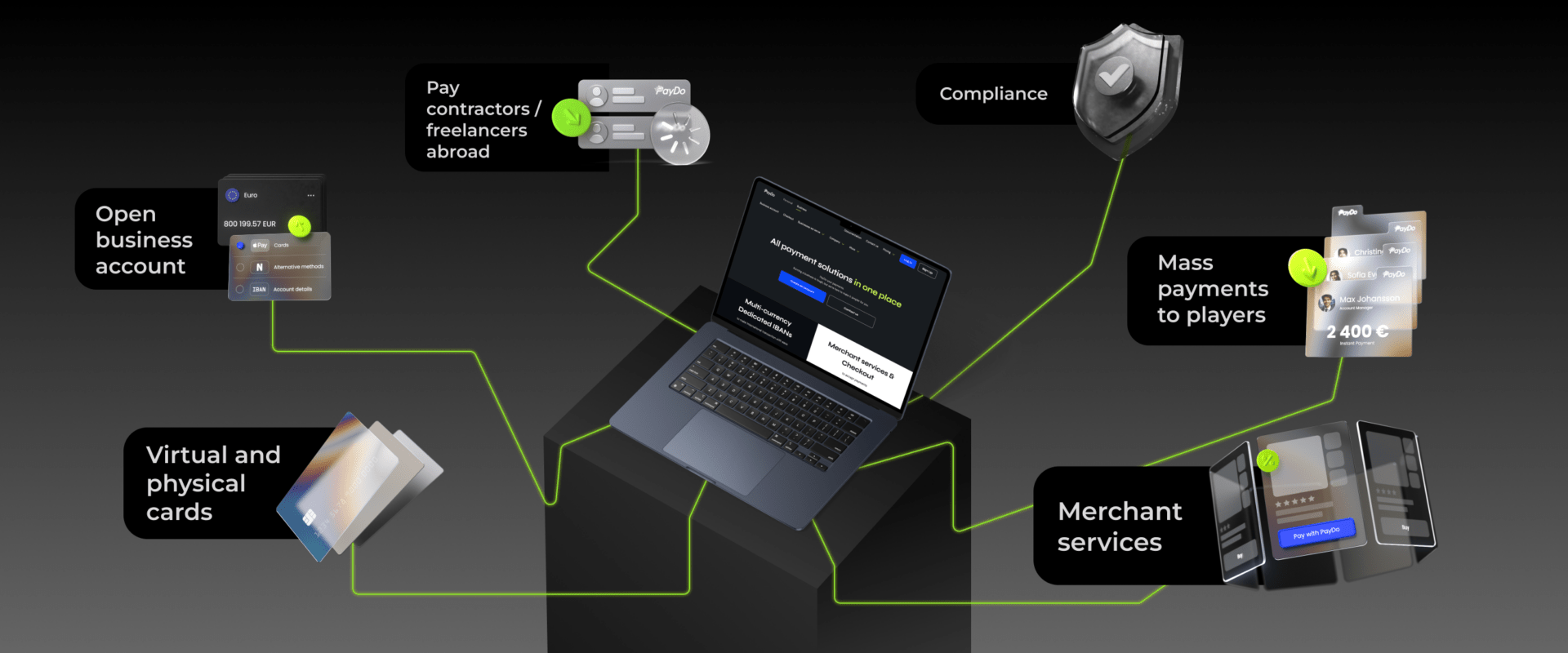
One of the reliable solutions is PayDo. Our range of products and services stands out from traditional banks and EMIs, providing a flexible solution for businesses looking to open business accounts. We tailor our requirements to the unique needs of the business sector, acknowledging the specific challenges and concerns they face. PayDo’s platform accelerates business account opening and facilitates multicurrency transfers.
You can send or receive cross-border, high-volume transfers using SEPA or SWIFT by opening a multicurrency account in 170 countries with 59 currencies (EUR, USD, GBP, AUD, CAD, and DKK) on PayDo.
The multicurrency business account with a dedicated IBAN allows our clients to use SEPA, SEPA Instant, and SWIFT. In addition, PayDo also provides local account details, granting access to FasterPayments for the UK.
With just a standard set of documents, you can have your account up and verified within 3-5 business days. Moreover, we cater to businesses from various regions, including the UK and EEA, without needing them to be physically present in these locations. By ultimately comprehending the needs of businesses, PayDo unveils broader opportunities for them.
3. Sign a contract, verify & use a business account
Setting up a PayDo Business account is a straightforward process. With just three simple steps, you’ll be ready to take advantage of this account’s features. Don’t miss out on this smooth and intuitive onboarding experience.
FAQ
Can non-residents open a business account remotely?
Yes, digital financial platforms allow remote onboarding using standard corporate documents without requiring a physical office.
How long does verification take?
Account verification typically takes 3 to 5 business days after submitting the required documents.
Final recap
Opening a business account for non-UK residents should not be as hard as it is right now. These requirements, such as needing a company’s physical presence in a location, can hinder growth. This particularly challenges non-UK/non-EU businesses, leading them to explore alternative solutions like EMIs.
With that in mind, PayDo a business account for non-UK residents can be set up an account in 48 hours using a standard set of documents. We serve businesses from diverse regions, including the non-UK and non-EEA, without requiring physical presence. PayDo’s deep understanding of business needs enables them to offer expanded opportunities.
The 30-Second Summary The fastest way for a digital goods platform to pay sellers in Europe and the UK is an instant transfer: SEPA Instant for euros and Faster Payments...
The 30-Second Summary Low transaction fees look like the obvious way to compare payment providers. Skin store owners start with the rate on the price sheet because it is the...
The 30-Second Summary A payment gateway for a game key store has one job: get buyers’ card payments approved and keep the account open as volume grows. For game key...
The 30-Second Summary SEPA Instant sends euros within the SEPA area in up to 10 seconds, 24/7. SWIFT works in almost any currency, but a transfer usually takes 1–2 business...
The 30-Second Summary In the fast-paced and ever-changing iGaming industry, what are the current best online casino payment methods? Today, we are taking a snapshot for 2025, when the iGaming...
The 30-Second Summary A Money Services Business (MSB) is a type of financial institution that offers various money-related services, such as money transfers, currency exchange, and check cashing. It is...
The 30-Second Summary Electronic Money Institutions (EMIs) and Money Services Businesses (MSBs) are becoming more and more popular. EMIs focus on digital transactions, providing electronic payment services and digital currency...
The 30-Second Summary Phishing remains a major cybersecurity threat, targeting individuals and businesses through fraudulent emails, messages, and websites. According to the Anti-Phishing Working Group (APWG), 3.8 million phishing attacks...
The 30-Second Summary As digital payments continue to grow, payment fraud remains a significant concern. According to Alloy’s 2026 State of Fraud Report, 67% of surveyed financial institutions and fintechs...
The 30-Second Summary A bank account ownership certificate, also known as a bank account certificate or proof of account ownership, is a document that says your bank account actually belongs...
The 30-Second Summary A Company Registration Number (CRN) is a code a business gets during incorporation. It acts as a distinct identifier for your company. It helps to differentiate your...
The 30-Second Summary Imagine each bank branch with its unique postal code — that’s what a branch code or sort code is in the financial world. It’s a set of...