An iGaming business typically needs at least five payment providers: a business account, contractor payments, website checkout, mass payouts to players and corporate cards.
Every extra provider adds a contract, an integration and another onboarding, which slows growth.
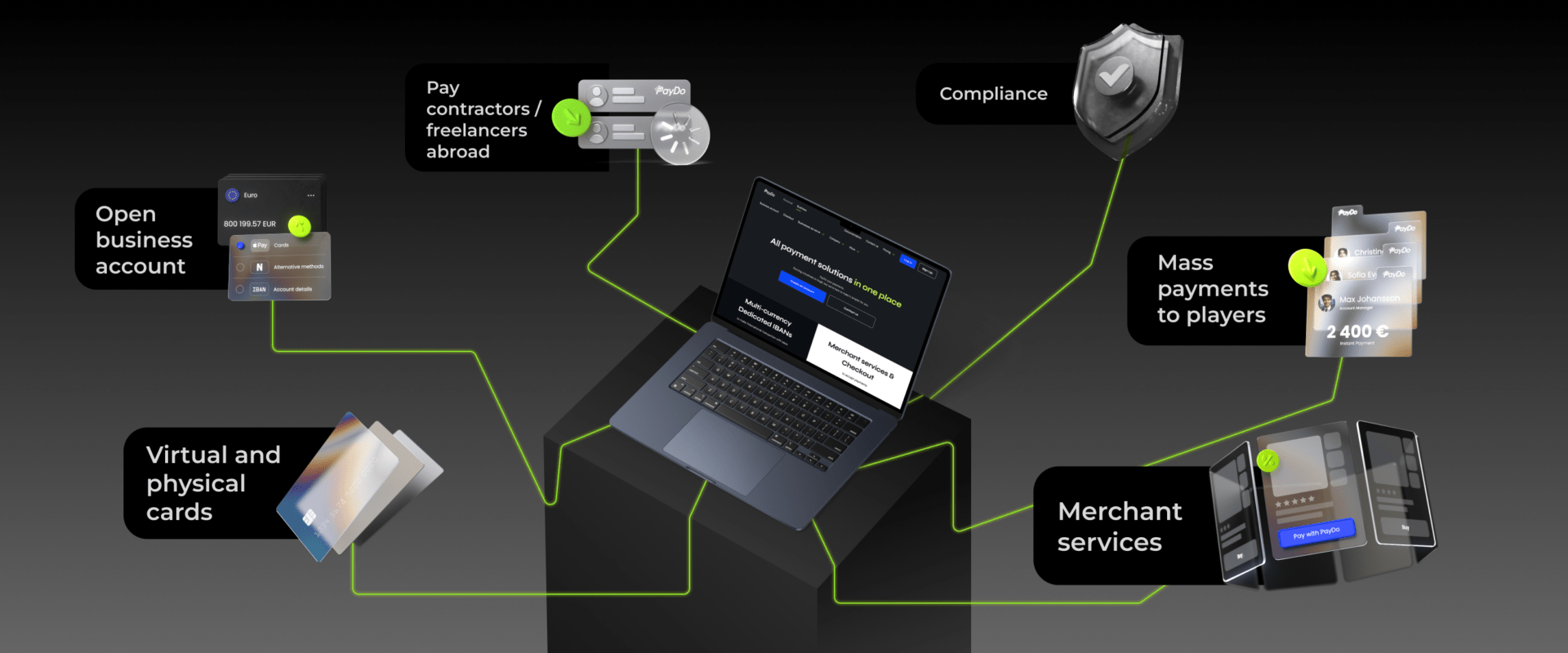
PayDo combines a dedicated multicurrency IBAN, merchant services, mass payouts and virtual and physical cards under one contract.
Starting and running a business is undeniably tough. According to recent statistics, about 10% of new companies fail within their first year and 90% fail over the long term. This means only 1 in 10 businesses overcome all the hurdles they face. How many payment providers do you need to have contracts with to ensure your business operates smoothly?
Running a business, for instance, in the iGaming industry, means having contracts with at least five payment providers. In the following sections, we’ll explain this in more detail and suggest a way to access five payment provider services under just one contract.
How Many Payment Providers Does an iGaming Business Need?
Starting an iGaming business involves several hurdles, and one of the first is opening a bank account for a business. As a business owner, you’ll need to approach various payment providers. They will ask numerous questions and require a lengthy list of documents.
If you’re fortunate, you’ll pass the verification and onboarding process after a couple of weeks, and your account will be up and running.
Note: Remember that you’ll need to share access to your account with authorized team members. Choosing a payment provider that understands and supports the industry in which you operate is also crucial. Otherwise, you may face significant challenges down the line.
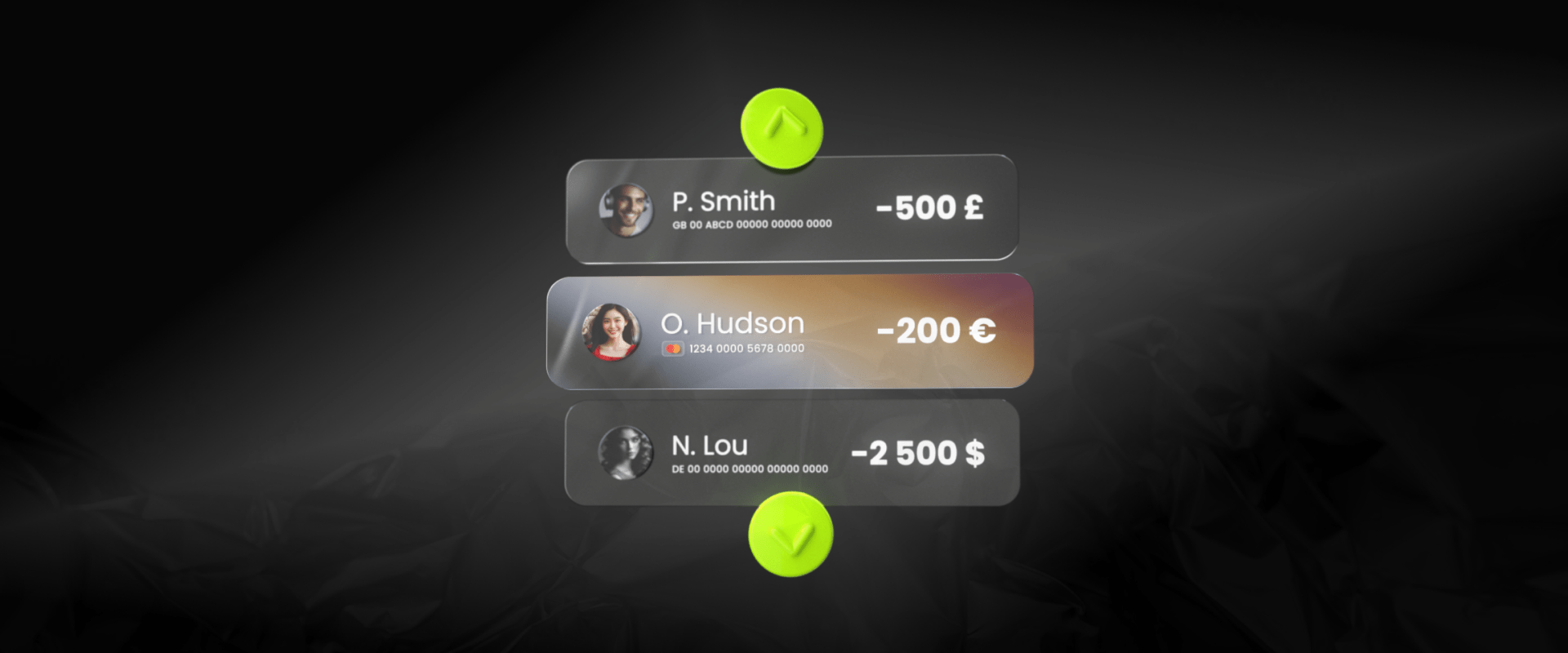
To pay them, you require SWIFT and SEPA transfers. However, you soon discover that while many payment providers offer SEPA, finding one that provides Cross-border is challenging.
Fortunately, you will find a payment provider that offers SWIFT and supports multiple currencies. You obtain an IBAN and begin paying salaries to your contractors abroad. This means you’ve now signed two contracts.
Note:Remember that you’ll likely have B2B contracts with your contractors, meaning you’ll send money to companies. TheSWIFT paymentprovider might ask additional questions if they operate in the digital services sector, potentially causing transfer delays. Many banks and Electronic Money Institutions (EMIs) don’t fully understand how digital businesses operate and may hesitate to engage with high-risk industries.
Checkout for Your Website
You have dealt with the business account and paid salaries to contractors. Now, you need checkout to accept payments because you have a website. In other words, you need a merchant provider. Most EMIs out there do not offer merchant services.
After many hours of research, you finally find the merchant provider. You sign a contract and have your checkout ready.
Note: With checkout, you need to focus on the integration aspect. If it is hard to integrate, you will spend resources and time on developers doing the task. Besides, as with the bank, with a merchant provider, you need a dedicated account manager to constantly update the information, which is hard.
Mass Payments to Players
After signing the third contract, you encounter another challenge: you need mass payout capabilities to ensure that players receive their winnings promptly. Many B2C payment providers don’t offer mass payment features.
Additionally, you require mass payouts via API integration. This is further complicated because different payment providers often cater separately to high-risk and low-risk businesses. Despite these hurdles, you find a payment provider offering mass payout services and sign your fourth contract.
Note: Always remember that with each payment provider, you need to build relationships, secure dedicated support, and keep your information updated. Having someone reliable on your side is crucial.
Second, you need a corporate card for expense management.
Third, to build your brand, you want physical cards that can be personalized for your employees.
Immediately, you discover the hard truth: most payment providers offer physical or virtual cards, but rarely both.
You manage to find that rare provider offering both plastic and virtual cards. You sign your fifth contract.
Note: Remember that each provider will have its own onboarding process, which can last months. The more providers you have, the more time you’ll spend on onboarding, documentation, support, etc.
The Matter of Compliance
Now that you have contracts with five payment providers, you might think you can breathe a sigh of relief. Unfortunately, that’s not the case.
Enter compliance.
As you navigate this path, you’ll frequently encounter regulations, jurisdictions, licenses, and other compliance issues that can be challenging for business owners.
With each payment provider on board, it’s crucial to ensure they hold the appropriate iGaming licenses. Moreover, they must be authorized to operate in the jurisdictions relevant to your business. You can’t afford to engage with dubious payment providers—not only because of regulatory requirements but also due to the ethical standards your company upholds.
Ignoring these compliance aspects can lead to swift and serious repercussions.
All Payment Solutions in One Place
PayDo is a payment ecosystem with a mission to provide all payment solutions in one place. With the platform, you get the services of five payment providers under one contract.
More specifically, PayDo offers:
I. Business Account with a Dedicated Multicurrency IBAN
Reome opening in 48 hours
Quick onboarding
Standard pack of documents
59+ currencies
170+ countries
SWIFT, SEPA, and seven more payment schemes
II. Merchant ServicesPayment Providers
No chargebacks
No holds
No rolling reserve
Easy API integration
350+ payment methods
Localization
Instant settlements
Conversion rate > 98%
Unlimited websites
III. Mass Payouts
Automatic payouts without any manual inputs
Customers receive their funds without fees
IV. Virtual and Physical Cards
Offer employees personalized cards.
Improve corporate expense management.
No limit on issuance.
And most importantly, PayDo is high-growth friendly and designed for iGaming business:
No volume restrictions.
No hidden fees
No minimal commitments
No minimal balances
No nonsense requirements
All iGaming licenses (Curacao included).
In-depth understanding of high-risk industries.
Curacao and other licenses supported
A dedicated account manager with extensive experience in iGaming
Momentary payouts
Scheduled payments
170+ destinations
PayDo operates under FCA, MFSA, and FINTRAC regulations.The payment ecosystem ensures PCI-DSS level 1 security and client funds safeguarding.
Frequently Asked Questions About All-in-One Payment Solutions
Businesses can streamline operations by combining accounts, payouts, and cards under a single provider.
What is the main benefit of an all-in-one payment ecosystem?
It allows companies to manage multiple financial operations through a single contract and dedicated support.
Are high-risk businesses supported?
PayDo provides dedicated financial services tailored for high-risk sectors under appropriate regulatory frameworks.
Conclusion
There is little more to say. Having an iGaming business is tough. However, with PayDo on your side, you can save many resources and time. Have five payment-provider services in one place and under one contract.
PayDo is designed with high-risk industries like iGaming in mind. With no volume restrictions, hidden fees, minimal commitments, and full support for all iGaming licenses—including Curaçao—you can operate confidently, knowing that compliance and regulatory requirements are thoroughly managed. A dedicated account manager with extensive experience in the iGaming sector ensures personalized support tailored to your business needs.
In an industry where time is money and compliance is non-negotiable, having a reliable, all-in-one payment solution is not just advantageous—it’s essential. PayDo empowers you to focus on what truly matters: growing your business and providing exceptional customer experiences.
Why complicate your operations with multiple providers when you can have all your payment solutions in one place under one contract? By choosing PayDo, you’re simplifying your payment processes and gaining a strategic partner committed to your success.
Don’t let complex payment logistics hold your business back. Open an account right now and take the first step toward a more streamlined, efficient, and compliant financial future. We’re ready when you are!
The 30-Second Summary The fastest way for a digital goods platform to pay sellers in Europe and the UK is an instant transfer: SEPA Instant for euros and Faster Payments...
The 30-Second Summary Low transaction fees look like the obvious way to compare payment providers. Skin store owners start with the rate on the price sheet because it is the...
The 30-Second Summary A payment gateway for a game key store has one job: get buyers’ card payments approved and keep the account open as volume grows. For game key...
The 30-Second Summary SEPA Instant sends euros within the SEPA area in up to 10 seconds, 24/7. SWIFT works in almost any currency, but a transfer usually takes 1–2 business...
The 30-Second Summary In the fast-paced and ever-changing iGaming industry, what are the current best online casino payment methods? Today, we are taking a snapshot for 2025, when the iGaming...
The 30-Second Summary A Money Services Business (MSB) is a type of financial institution that offers various money-related services, such as money transfers, currency exchange, and check cashing. It is...
The 30-Second Summary Electronic Money Institutions (EMIs) and Money Services Businesses (MSBs) are becoming more and more popular. EMIs focus on digital transactions, providing electronic payment services and digital currency...
The 30-Second Summary Phishing remains a major cybersecurity threat, targeting individuals and businesses through fraudulent emails, messages, and websites. According to the Anti-Phishing Working Group (APWG), 3.8 million phishing attacks...
The 30-Second Summary As digital payments continue to grow, payment fraud remains a significant concern. According to Alloy’s 2026 State of Fraud Report, 67% of surveyed financial institutions and fintechs...
The 30-Second Summary A bank account ownership certificate, also known as a bank account certificate or proof of account ownership, is a document that says your bank account actually belongs...
The 30-Second Summary A Company Registration Number (CRN) is a code a business gets during incorporation. It acts as a distinct identifier for your company. It helps to differentiate your...
The 30-Second Summary Imagine each bank branch with its unique postal code — that’s what a branch code or sort code is in the financial world. It’s a set of...