The 30-Second Summary
- A multicurrency business account holds balances in several currencies behind one IBAN. Euro payments arrive over SEPA, and other currencies over SWIFT.
- Check whose name is on the IBAN. Since October 2025, payers in the euro area see a name check before they pay, and an IBAN registered in the provider’s name can return a mismatch warning.
- PayDo gives business clients a dedicated IBAN in the company’s name, with SEPA, SEPA Instant and SWIFT transfers from one account and one dedicated account manager.
Business accounts with multicurrency IBANs are offered by electronic money institutions and by some banks. For international transfers, the differences sit in two places: whose name is on the IBAN, and which payment systems the account reaches. Both decide whether clients pay you on time and how much reaches you.
What a multicurrency IBAN does
One IBAN identifies your account, and balances in several currencies sit behind it. Clients in Europe pay it in euros over SEPA, and clients elsewhere pay it over SWIFT.
The IBAN system is used by 89 countries, including all EU and EEA countries and the UK. The United States, Canada and Australia don’t use IBANs. Payers there send money over SWIFT using your IBAN and your provider’s BIC.
Within SEPA, an IBAN from another country works the same as a local one. Companies must accept IBANs from other SEPA countries for euro transfers under Article 9 of the SEPA Regulation.
Dedicated or pooled IBAN
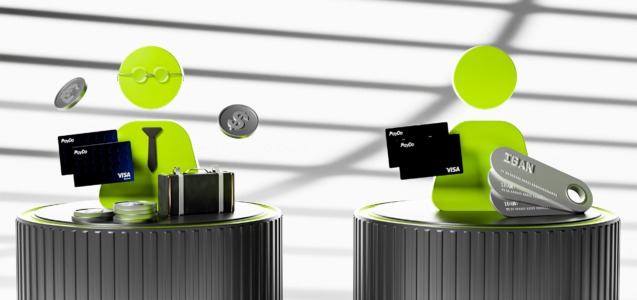
A dedicated IBAN is issued in your company’s name, so your company is the beneficiary. A pooled IBAN is registered in the provider’s name, and incoming payments are matched to your account by a reference.
The difference became visible in October 2025. Euro transfers now come with a payee name check: the payer’s bank asks the receiving provider whether the name matches the IBAN. The receiving provider decides what counts as a match, and accounts shared by several entities often produce close match or no match results.
For a company that invoices clients, a mismatch warning means a client may pause the payment or call to check. A dedicated IBAN in your company’s name avoids that.
Which payment systems the account reaches
For euros, the account should send and receive SEPA and SEPA Instant transfers. For other currencies, it needs SWIFT.
A SEPA Instant transfer takes up to 10 seconds. Since 9 October 2025, payment providers in the euro area may not charge more for an instant euro transfer than for a standard one. SWIFT payments can pass through intermediary banks, and each one can deduct a fee on the way. Ask how many intermediaries usually sit on the routes you use most.
What it costs to hold and convert currencies
Ask for the full price list before you open the account: account fees, incoming and outgoing transfer fees, and the margin on currency conversion.
Conversion margins add up for companies paid in one currency and paying out in another. Holding balances in the currencies you pay most often means you convert only when you choose to. How fees work on contractor payments is covered in how to pay international contractors in multiple currencies.
Checklist: what to ask before you open an account
| Question | Why it matters |
|---|---|
| Is the IBAN dedicated, in my company’s name? | Clients see a name match when they pay |
| Which currencies can I hold and convert? | You convert only when you choose to |
| Do you send SEPA Instant transfers? | Euro payments settle in seconds |
| Which currencies can I send over SWIFT? | Covers clients and contractors outside the euro area |
| What is the full fee list, including conversion? | The account fee is only part of the cost |
Why PayDo fits IT and service companies
PayDo opens business accounts for UK and EU companies in 3–5 business days, with a dedicated IBAN in the company’s name.
- Clients see your name. A dedicated IBAN in your company’s name, so the payee name check returns your company.
- Euro payments in seconds. SEPA and SEPA Instant transfers from the same Business Account.
- Clients and contractors outside the euro area. SWIFT transfers in other currencies.
- Several currencies in one place. Hold balances in several currencies and convert inside the account.
- Paying contractors. Mass Payments via API in EUR and GBP.
- One person to call. A dedicated account manager from onboarding onwards.
To open a PayDo Business Account, send your company details and expected monthly volume to the PayDo sales team. If your current provider closed your account, see what to do after a Revolut Business closure.
FAQ
Does PayDo offer a multicurrency business account with an IBAN?
Yes. PayDo business clients get a dedicated IBAN in the company’s name, balances in several currencies, and SEPA, SEPA Instant and SWIFT transfers from one account.
What is the difference between a dedicated and a pooled IBAN?
A dedicated IBAN is issued in your company’s name. A pooled IBAN is registered in the provider’s name, and payments are matched to your account by a reference.
Can a client refuse to pay an IBAN from another country?
Not for euro transfers within SEPA. Article 9 of the SEPA Regulation requires payers and payees to accept IBANs from other SEPA countries.
Can US clients pay an IBAN?
Yes, over SWIFT. The United States doesn’t use IBANs domestically, so US payers send an international transfer using your IBAN and your provider’s BIC.
What is Verification of Payee?
Since 9 October 2025, payment providers in the euro area check that the payee’s name matches the IBAN before a euro transfer. The payer sees a match, close match or no match result.