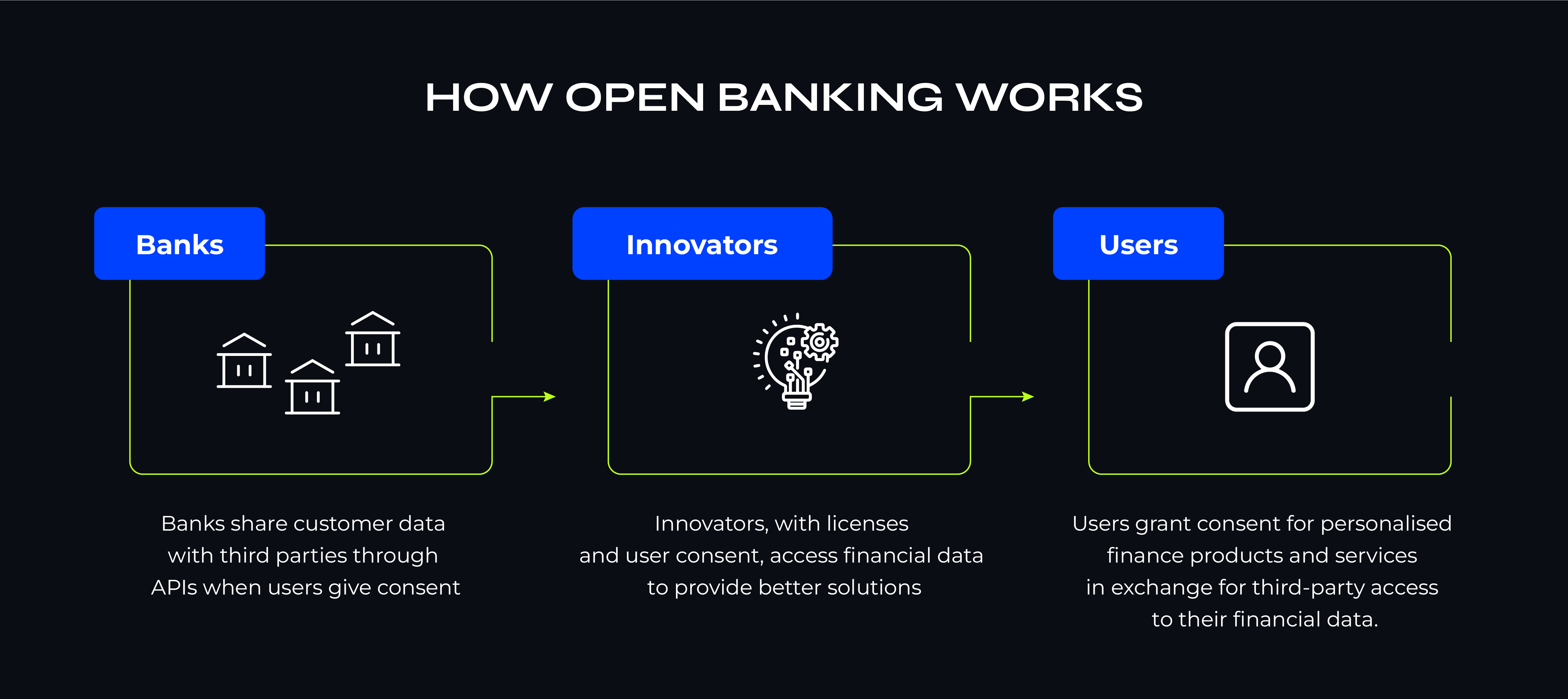
Open banking lets customers share their bank data with licensed third-party apps through secure APIs, only with their explicit consent.
Third parties can then show account data or make transactions on the customer’s behalf.
It is driven by regulations such as PSD2 in the EU and UK and benefits consumers, banks and fintech companies.
What is open banking? This fairly new phenomenon in the world of financial technology is gaining a lot of traction, but what does it really mean, and how does open banking work? Spoiler: it has more to do with data access than finances and transactions, commonly associated with the term “banking”. Read on to find out more.
What Is Open Banking?
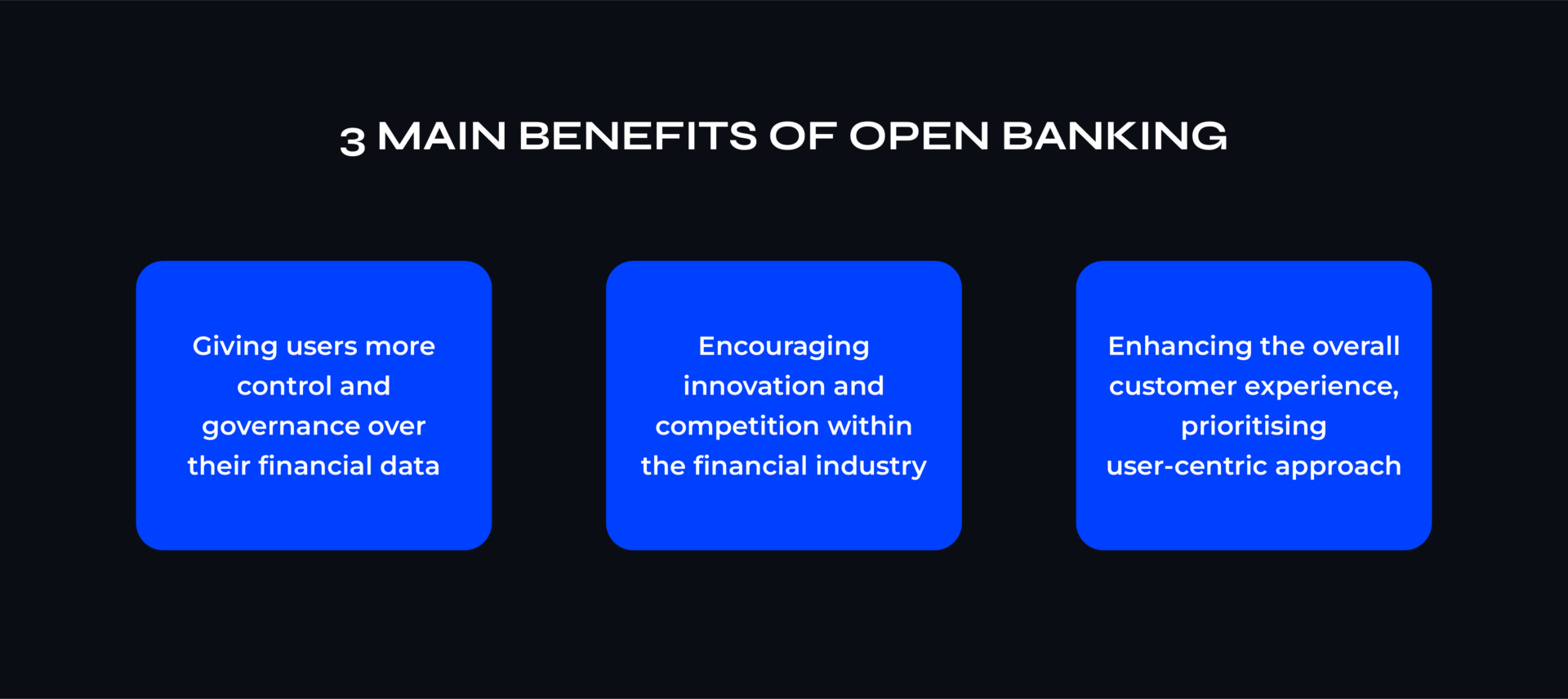
Open banking is a new approach to handling banking information. Also called “open bank data”, this strategy lets consumers securely share their financial information with authorized third-party providers like payment services and apps for budgeting. The main goals are greater personalization of financial services and the chance to speed up transactions. A regular bank transfer with traditional banking can get stuck in processing for over a day and the tools offered by bank can be quite limiting, so customers should be allowed to venture outside of these limitations.
Instead of manually connecting the dots and clicking on checkmarks in multi-stage banking transactions, open banking creates a digital infrastructure where access to data is a given. Think of it as the difference between many individual messages in a bank-controlled messenger versus a group chat of your creation. As for open banking pros and cons, the first approach is a bit more rigid, but may feel more secure, where in the second scenario the choice of who joins the “group chat” with the user’s sensitive information is on the user, but the consequent collaboration makes things much easier later on.
The core principle: sharing financial data securely
The customers having to consent to sharing their data with more institutions for these instructions to interconnect is a concern that always bubbles up during open banking discussions, and “is open banking safe” gets asked a lot. Before sharing financial data, look into security measures used by the third-party providers that will receive it. They should comply with regulatory standards like GDPR and PSD2. Other things to look for are a focus on API security, multi-factor authentication, and encryption for data both in transit and at rest.
Key players: banks, third parties, customers
It is important to understand that the main juxtaposition is not between bank control versus customer control over data. The definition of open banking does not paint all banks as its counterpart – they are allies. The juxtaposition is between traditional banks that do not subscribe to open banking practices, and the banks that do.
Three groups are involved in the open banking system:
Banks hold and safeguard customer information.
Third-party providers use customer data to inform their services.
The customer decides whether to share their data and with whom.
What Is the Difference Between Open Banking and Traditional Banking?
Seeing the difference from traditional banking is the easiest way to understand the inner workings and definition of open banking.
Aspect
Open Banking
Traditional Banking
Data Access
Customer data shared with third parties via APIs
Data kept within the bank’s own systems
Customer Control
Customers control who accesses their data
Bank controls access to customer data
Innovation
Encourages fintech innovation and new services
Usually limited to bank-developed tools
Third-party Services
Supports integration with external apps
Rarely integrates external services
Security Standards
Regulated API access with strong customer authentication
Internal systems with traditional security protocols
Transparency
More transparent, customer decides data usage
Less transparent, limited visibility on data usage
Regulation
Driven by regulations like PSD2 (EU/UK)
Governed by traditional banking regulations
User Experience
Often more personalized and flexible
Often rigid and less customized
How Does Open Banking Work in Practice?
So, how does open banking work, really?
API connections and authentication
Through third-party APIs, third-party providers can access customer data, including information about their financial transactions and counterparties. Banks grant third-party service providers access and control over their customers’ financial and personal data, customers log into their bank using strong customer authentication, give consent for this access, and after that open banking can really happen.
Customer consent and permissions
Before any data is shared, explicit customer consent is required. Users must authorise the release of their information to specific third-party providers. Open banking APIs let customers use different services from different providers, but they also need customers to share their data. This may make some customers wonder “is open banking safe”? Providers must teach and tell the customers about the good and bad things of open banking, as well as what they can and must do.
Data flow: from bank to third-party app
Third parties can make new transactions and account changes on the customer’s behalf. Here’s how the process looks chronologically:
User Consent. The user initiates the process by giving access the third-party provider.
Redirection to Bank. Third-party provider redirects the user to their bank’s authentication page.
Strong Customer Authentication. The user logs in to their bank using password and, for instance, SMS code or biometrics to confirm their identity.
Access Token. One of benefits of open banking is tokenization, and the safety that comes with it. Once authenticated, the bank issues a secure access token via APIs.
Data Transmission. Using the token, the third-party gets the user’s banking data through standardized open banking APIs.
Data Display. The third-party app processes and displays the result to the user.
What Are the Benefits of Open Banking?
So, what is open banking adding into the world of modern finance? It will be easier to split the answers into sub-categories: customers, financial institutions, and third-party providers.
Benefits for consumers
Here are the perks of using open banking for business and personal purposes on the consumer’s end.
Consolidated view of all financial accounts.
Ability to manage multiple accounts, connected with open data.
Real-time updates on account balances and transactions.
Personalized financial services.
More providers equals more choices.
Third-party apps make budgeting more advanced.
Benefits for financial institutions
These are the benefits of open banking for banks that agree to participate in this system.
Monetisation of APIs by charging fees for data access.
Creation of value-added services that attract additional customers.
Expansion into new markets and customer segments.
Personalised offerings boost customer engagement.
Quick and efficient customer query resolution.
Ability to address evolving customer needs with agility.
Benefits for fintech and third-party providers
For third-party providers that are on the receiving end of customer data, the advantages of open banking are also pretty clear.
Access to customer data from multiple institutions via APIs.
Niche and specialised financial services are easier to market.
Lower barriers to entry, and a more competitive landscape as a result.
Building upon existing banking infrastructure to create innovative solutions.
Access to a broader customer base through partnerships with traditional banks.
What Is an Example of an Open Banking App or Service?
Let’s delve into some real-life case studies that showcase the practical applications of this technology. These examples of open banking highlight how this financial innovation is making a difference in day-to-day scenarios.
Circit
Circit is a good example of using open banking for business. An audit platform, it leverages open banking to streamline administrative tasks for law firms, fund managers, and accountants a payment. By speeding up key processes, they enhance efficiency and accuracy in financial administration.
This platform expands access to loans for HEY Credit Union customers. By utilising open banking, they assess and fund member loans more swiftly, benefiting credit card union members.
Deutsche Bank’s Retail Deposit Marketplace
Deutsche Bank has partnered with Deposit Solutions to create an exclusive retail deposit marketplace – a pioneering move among major global banks, which aligns closely with the open banking meaning. Through its white-label solution called “ZinsMarkt,” Deutsche Bank now offers deposit products from other banks to its own customers.
This marketplace seamlessly integrates with Deutsche Bank’s online banking and is also accessible through client advisors at the bank’s branches. With the potential to reach seven million German retail customers, Deutsche Bank strengthens its position as a central digital platform for all its financial service requirements.
How to Start Using Open Banking—Step by Step
Decided to give open banking a try? These should be your first steps:
Confirm that your bank supports open banking. With the widening adoption of open banking for business companies, most large banks now offer open banking access. Check your online banking settings or speak with your bank to find the relevant options.
Choose a registered third-party provider. Look for financial services that are officially authorised to access banking data. These may include tools for managing expenses, planning savings, or consolidating multiple accounts.
Authorise access through your bank. Connect an app and you’ll be sent to your bank’s secure login. After signing in, choose which accounts to link and what information the app can view. That is the main part, completed: now you are free to enjoy the benefits of open banking.
After these steps are complete, the setup process is over, but there are also some ground rules to keep in mind to make the experience continuously safe.
Check and manage permissions regularly. Double-check which services have access to your data to be sure that there is no new unfamiliar software taking advantage of your information. You can remove access for any third-party app, at any time.
Take note of expiry periods – most data-sharing permissions expire after 90 days. You will need to renew your permissions if you want them to stay the same in the long term.
Never share your banking password with any third party. Authorised apps use encrypted tokens to access your data, not your login credentials. Emails or texts pretending to be an authorized souce and asking for your password are likely to be a phishing attack.
Open Banking Across Europe & UK
The open banking meaning will be the same in different parts of the world, but the regulatory frameworks that surround it all vary across regions. The most well-known examples of open banking regulations in Europe are PSD2, PSRs, and OBIE.
PSD2 (Revised Payment Services Directive) is a set of laws in the European Union (EU). It improves payment services for consumers this by:
Setting security standards.
Encouraging competition and innovation in the banking market.
With PSD2, banks in the EU must let their customers safely share data with other companies. PSD2 started on November 25, 2015, and EU countries had until January 13, 2018, to make it a part of their own laws.
In the UK, open banking has evolved through various initiatives like PSRs and OBIE:
Payment Services Regulations (PSRs) established the legal and regulatory framework for open banking in 2017, incorporating PSD2 into UK law.
Open Banking Implementation Entity (OBIE) was created by the Competition and Markets Authority (CMA) in 2018 and developed an open banking standard for account access. Nine largest UK banks (known as the CMA9) use this standard, and other banks comply with the Payment Services Regulations.
Conclusion
Learning the open banking meaning and its inner workings is paramount to be truly caught up on modern advancements in financial technology. Open banking is here to stay, with regulators adapting to technology advancements.
At PayDo, we always keep up with the latest trends and innovations within the financial landscape.
Whether you’re a startup, a growing enterprise, or an established business, our business account caters to your needs without requiring residence restrictions.
Open banking is a financial technology framework that allows consumers to securely share their banking data with authorised third-party providers through APIs. It enables faster transactions, personalised services, and integration with budgeting apps or payment platforms. Customers remain in control, deciding who accesses their financial information and for what purpose.
Is open banking safe?
Yes, open banking is safe if providers follow strict regulations like PSD2 and GDPR. Security relies on API protection, multi-factor authentication, and encryption of data in transit and at rest. Customers must always give explicit consent and can revoke access anytime, ensuring transparency and control over their financial information.
How does open banking support fintech innovation?
Open banking enables startups to build specialised services like budgeting apps, instant payments, and lending platforms. It creates a more competitive landscape, expands consumer choice, and encourages banks to enhance offerings.
What are the benefits of open banking for business?
Open banking for business improves efficiency, reduces processing delays, and supports integration with modern financial tools. It strengthens competitiveness, customer engagement, and market expansion opportunities.
The 30-Second Summary Low transaction fees look like the obvious way to compare payment providers. Skin store owners start with the rate on the price sheet because it is the...
The 30-Second Summary A payment gateway for a game key store has one job: get buyers’ card payments approved and keep the account open as volume grows. For game key...
The 30-Second Summary SEPA Instant sends euros within the SEPA area in up to 10 seconds, 24/7. SWIFT works in almost any currency, but a transfer usually takes 1–2 business...
The 30-Second Summary In the fast-paced and ever-changing iGaming industry, what are the current best online casino payment methods? Today, we are taking a snapshot for 2025, when the iGaming...
The 30-Second Summary A Money Services Business (MSB) is a type of financial institution that offers various money-related services, such as money transfers, currency exchange, and check cashing. It is...
The 30-Second Summary Electronic Money Institutions (EMIs) and Money Services Businesses (MSBs) are becoming more and more popular. EMIs focus on digital transactions, providing electronic payment services and digital currency...
The 30-Second Summary Phishing remains a major cybersecurity threat, targeting individuals and businesses through fraudulent emails, messages, and websites. According to the Anti-Phishing Working Group (APWG), 3.8 million phishing attacks...
The 30-Second Summary As digital payments continue to grow, payment fraud remains a significant concern. According to Alloy’s 2026 State of Fraud Report, 67% of surveyed financial institutions and fintechs...
The 30-Second Summary A bank account ownership certificate, also known as a bank account certificate or proof of account ownership, is a document that says your bank account actually belongs...
The 30-Second Summary A Company Registration Number (CRN) is a code a business gets during incorporation. It acts as a distinct identifier for your company. It helps to differentiate your...
The 30-Second Summary Imagine each bank branch with its unique postal code — that’s what a branch code or sort code is in the financial world. It’s a set of...
The 30-Second Summary When you think of it, digital finance is truly all about an exchange of codes – money hidden in chains of letters and numbers, but how to...