Dankort, Denmark’s national debit card, and the mobile wallet MobilePay are the country’s most popular payment methods, alongside PayPal and SEPA transfers.
A good payment setup for Denmark needs strong security, easy integration with your systems and transparent transaction fees.
Merchants entering the Danish market should offer these local methods to win local customers.
Experts regard the Danish market for its innovative payment processing schemes, which creates a unique opportunity for businesses to expand. Danes use Dankort all over the world. And mobile payment platforms like MobilePay is insanely popular in Denmark. Understanding these options is crucial for a successful entry into the market. The guide will help you navigate Denmark’s digital payment landscape and select the right payment processing schemes for your business.
Overview of payment processing schemes and methods in Denmark
Cash is fading fast. In 2025 it was used for just 9% of in-store payments, down from 23% in 2017. Phones are taking over: almost a third of all card payments now go through digital wallets like Apple Pay and Google Pay.
Danes use a mix of global and local payment methods. For cross-border transfers in euro, SEPA is the standard. At home, two local methods dominate.
Dankort
Dankort is Denmark’s national debit card and the country’s most-used card by number of transactions. It launched in 1983 as an alternative to cash, cheques and foreign cards, and went contactless in 2015. Today more than 80% of Dankort payments are contactless, and since 2022 the card can be added to Apple Pay.
Dankort works inside Denmark. Most Danes carry a co-branded Visa/Dankort card: it runs on Dankort at home and on Visa abroad. For any business selling to Danish customers, accepting Dankort is a must.
MobilePay
MobilePay launched in 2013 and has become the default way Danes send money to each other, pay in shops and check out online. By the end of 2025 it had 4.74 million users in Denmark, in a country of about 6 million people. In 2022 MobilePay merged with Norway’s Vipps to form Vipps MobilePay, which now serves 12.4 million users across the Nordics.
To sign up, a user needs a Danish CPR number, a Danish bank account and a card. So every MobilePay account is tied to a verified Danish resident.
Notably, Danes consider MobilePay more essential than popular social media apps like Facebook and Instagram. This highlights its crucial role in the Danish online payment ecosystem.
PayPal
PayPal is one of the most popular online payment methods in the world. It is also widely used in Denmark.
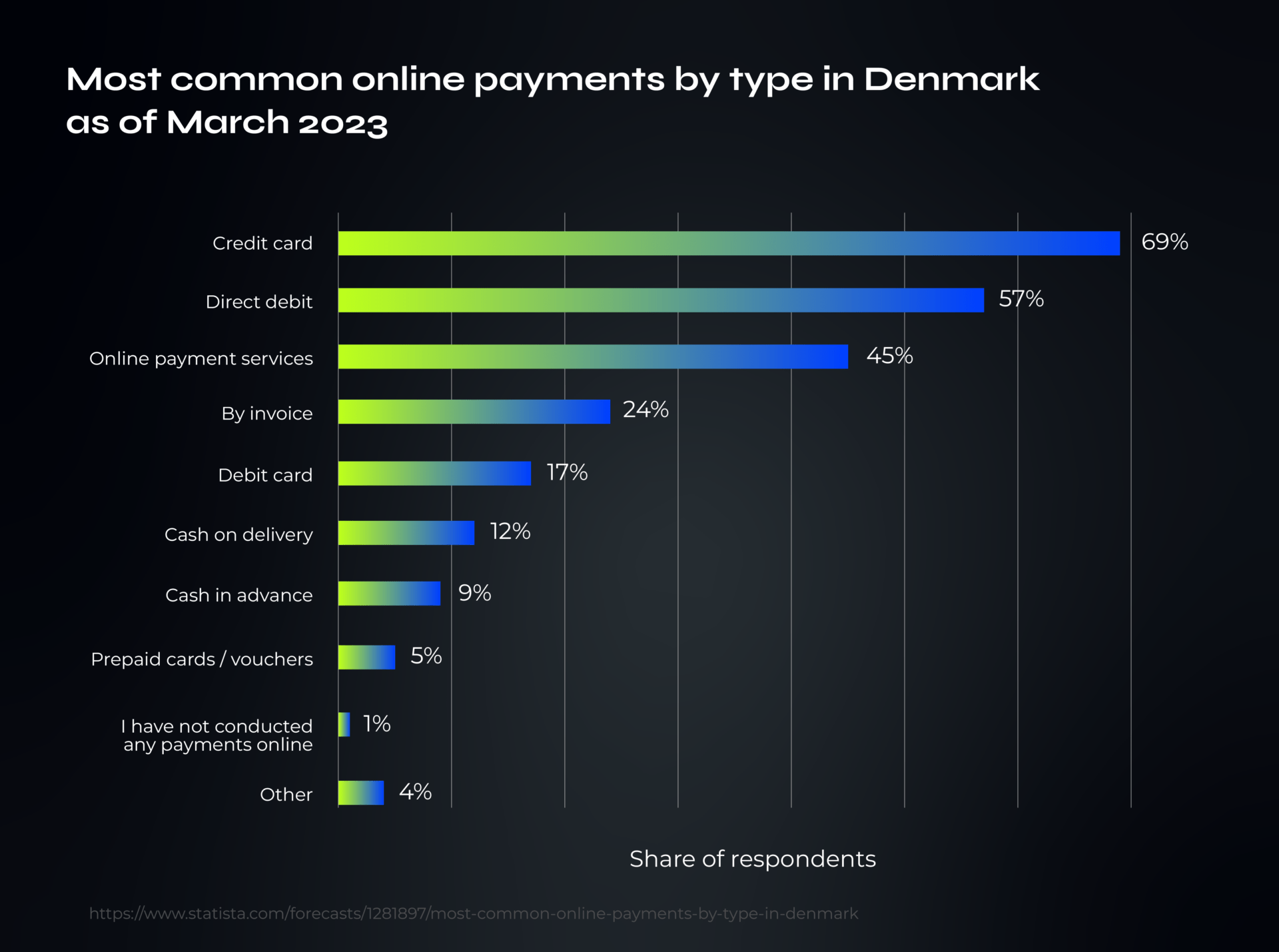
According to Statista data, PayPal is one of the most common online payments by type in Denmark as of March 2023. 45% of surveyed people use this service (along with Amazon Pay) to pay online.
PayPal is valued for its global presence. It’s everywhere in the world, making it easy for transactions across borders and connecting businesses globally.
Key features of good payment processing schemes
A good payment processing scheme should handle transactions, build trust, and adapt to different business needs. Here are some key features:
Security
Strong payment processing schemes use advanced encryption to protect sensitive information during transactions. This includes credit card details and ensures they remain confidential and protected from unauthorised access.
Implementing measures to detect and prevent fraud adds an extra layer of security. This involves real-time monitoring for suspicious activities, verifying transactions, and the ability to flag or block potentially fraudulent transactions.
Integration
An effective payment processing scheme smoothly works with existing business systems. Like accounting software and inventory management. This makes the overall process more streamlined. It also reduces the need for manual data entry and minimises errors.
A versatile system accommodates various payment methods such as credit cards, debit cards, digital wallets, and emerging forms of payment. This flexibility caters to a wider customer base, enhancing the overall user experience.
Transaction fees
Transparent communication about transaction fees is crucial for building trust. Clearly outlining fees for services like processing payments, chargebacks, and currency conversion (if applicable) helps businesses understand the cost implications.
A good payment system offers competitive rates compared to industry standards. This helps businesses manage costs and ensures that customers find the payment process reasonable. Potentially encouraging more transactions.
Addressing these key features helps you create a secure, efficient, and cost-effective financial environment for your payers. For instance, PayDo provides encryption and fraud prevention, integrating seamlessly with various business tools. We also transparently communicate transaction fees, offering competitive rates to both small and large businesses.
Consideration for cross-border merchants
Choosing a payment gateway for your business site or app can be challenging. Opt for a high-risk payment processor that ensures consistent payments for your app/site. An ideal payment processor, with an payment gateway and casino merchant account, should have the following features:
Strict security measures
The casino merchant account must adhere to the strictest PCI-DSS guidelines and incorporate security features such as fraud scoring, tokenisation, and 3D secure authentication to protect merchants from fraud.
Advanced solutions to prevent chargebacks
At PayDo, users pay for goods and services from their PayDo account. As a result, chargebacks are reduced to a minimum.
Support for foreign currencies
The payment processor should support all major foreign currencies to cater to a diverse customer base. PayDo offers 18 of the most popular currencies to meet your needs for global payments.
Transparent fee disclosure
The payment processor must disclose all charges to ensure transparency in financial transactions.
24/7 Customer and technical support
An ipayment processing business should provide continuous customer and technical support to address any concerns or issues that may arise.
Regulatory compliance
Cross-border transactions require compliance with various laws, tax regulations, and financial standards. Merchants must stay informed and adhere to these guidelines for smooth cross-border operations.
When choosing a payment provider for your business, focus on the above mention key features. When finding a simpler approach, you can always look for an EMI with experience accommodating international transactions and cross-border merchants.
PayDo provides payment processing schemes to help Danish customers enjoy hassle-free transactions
By opening a PayDo Business Account, you can access dedicated and pooled multicurrency IBANs.
With PayDo, you can send and collect payments globally through various schemes, such as SEPA, SEPA Instant, and Cross-border. We also provide competitive pricing for business accounts. The pricing is calculated depending on the country of incorporation and industry of the business.
All our products (Business Account, Merchant Services, Mass Payments) are available by default, without additional fees, in one dashboard.
Create a PayDo Business account today and explore the possibilities of multiple local and global payment processing schemes for your business.
FAQ
Find quick answers to common questions about payment methods and processing schemes in Denmark.
What are the most popular payment methods in Denmark?
Dankort and MobilePay are the most popular payment options in Denmark, alongside global methods like PayPal and SEPA.
How can businesses accept local payments in Denmark?
Businesses can integrate local payment schemes and use business accounts to process transactions securely and quickly.
Conclusion
Denmark’s online gambling industry experienced substantial growth over the past few years. The country’s liberal regulatory environment and high internet penetration have played pivotal roles in this success.
Understanding the local payment landscape is crucial for those venturing into the Danish market. In this article, we’ve explored some of Denmark’s most popular payment options.
With a PayDo Business account, you can provide your Danish users with reliable and fast payment methods they know and love.
Contact us to learn more about the benefits of a PayDo account for your business.
The 30-Second Summary The fastest way for a digital goods platform to pay sellers in Europe and the UK is an instant transfer: SEPA Instant for euros and Faster Payments...
The 30-Second Summary Low transaction fees look like the obvious way to compare payment providers. Skin store owners start with the rate on the price sheet because it is the...
The 30-Second Summary A payment gateway for a game key store has one job: get buyers’ card payments approved and keep the account open as volume grows. For game key...
The 30-Second Summary SEPA Instant sends euros within the SEPA area in up to 10 seconds, 24/7. SWIFT works in almost any currency, but a transfer usually takes 1–2 business...
The 30-Second Summary In the fast-paced and ever-changing iGaming industry, what are the current best online casino payment methods? Today, we are taking a snapshot for 2025, when the iGaming...
The 30-Second Summary A Money Services Business (MSB) is a type of financial institution that offers various money-related services, such as money transfers, currency exchange, and check cashing. It is...
The 30-Second Summary Electronic Money Institutions (EMIs) and Money Services Businesses (MSBs) are becoming more and more popular. EMIs focus on digital transactions, providing electronic payment services and digital currency...
The 30-Second Summary Phishing remains a major cybersecurity threat, targeting individuals and businesses through fraudulent emails, messages, and websites. According to the Anti-Phishing Working Group (APWG), 3.8 million phishing attacks...
The 30-Second Summary As digital payments continue to grow, payment fraud remains a significant concern. According to Alloy’s 2026 State of Fraud Report, 67% of surveyed financial institutions and fintechs...
The 30-Second Summary A bank account ownership certificate, also known as a bank account certificate or proof of account ownership, is a document that says your bank account actually belongs...
The 30-Second Summary A Company Registration Number (CRN) is a code a business gets during incorporation. It acts as a distinct identifier for your company. It helps to differentiate your...
The 30-Second Summary Imagine each bank branch with its unique postal code — that’s what a branch code or sort code is in the financial world. It’s a set of...