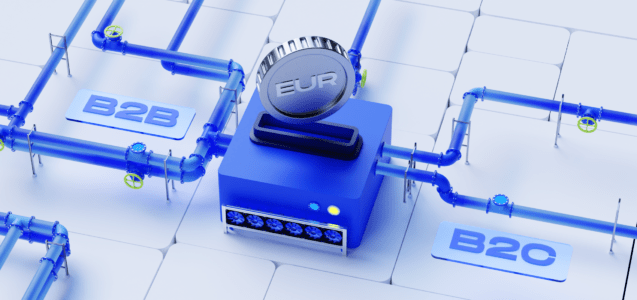
B2B payments are larger, recurring and paid on longer invoicing cycles, often after the product or service is delivered.
B2C payments are smaller and instant, so speed, ease of use and protection for individual buyers matter most.
Hybrid models like B2B2C need payment infrastructure that handles business and consumer transactions in one place.
Digital payments continue to transform commerce as businesses seek faster payment processing, greater automation, and improved control over financial operations. According to 360iResearch, the global B2B payments market is estimated at $5.31 trillion in 2026 and projected to reach $8.15 trillion by 2032. Meanwhile, Global Industry Analysts forecasts that the global B2C payment market will grow from $1.6 trillion in 2025 to $3.4 trillion by 2032, reflecting continued expansion across both business and consumer payments.
But what exactly are B2B and B2C payments? What sets them apart—and how do they differ from each other? In this guide, we break it down to help fintech providers develop tailored software solutions for each payment model.
What are B2B and B2C Models?
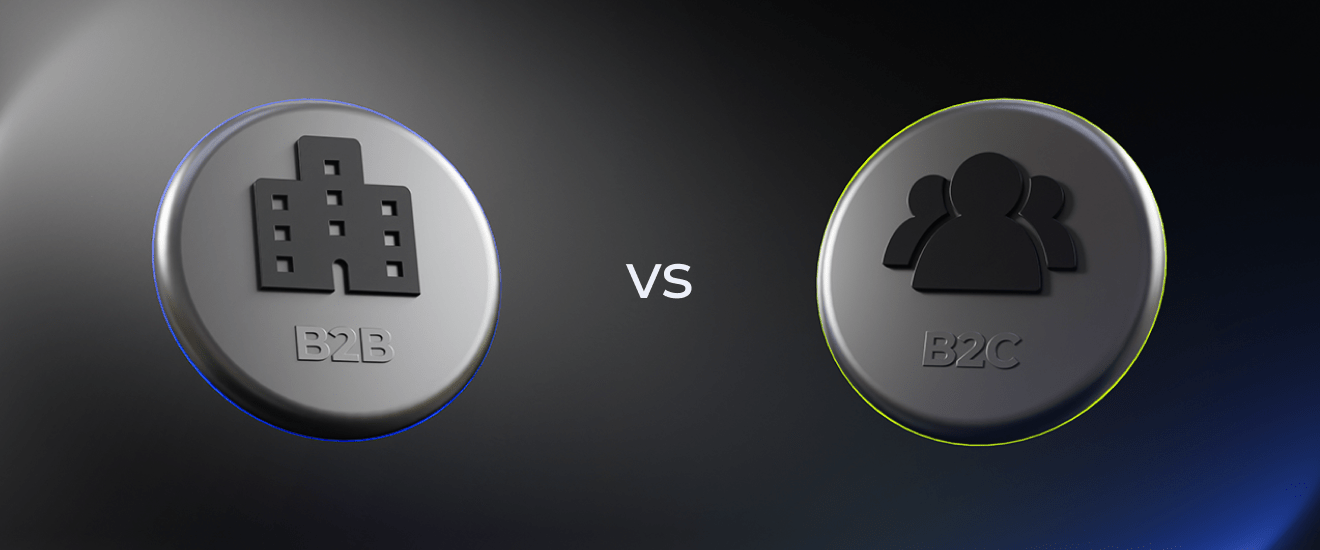
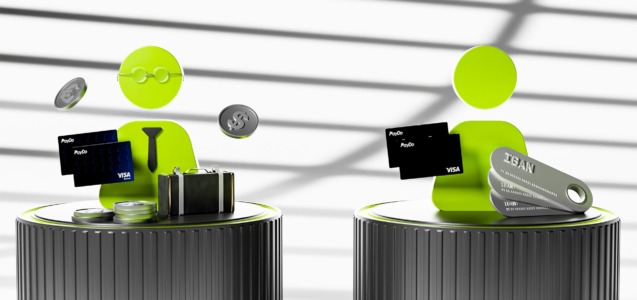
B2B and B2C represent two common business models based on the target audience: Business-to-Business (B2B) and Business-to-Consumer (B2C). B2B companies provide products or services to other businesses, while B2C companies cater to individual consumers.
It’s also common for companies to engage in both models—offering bulk deals for businesses and smaller-scale products for consumers. Some go a step further by adopting hybrid approaches such as B2B2C (Business-to-Business-to-Consumer) or B2C2B (Business-to-Consumer-to-Business).
What Is the Difference Between B2B and B2C Payments?
At first glance, it might seem like payment types don’t differ much between B2B and B2C. But in reality, payment infrastructure requirements can vary significantly. For banks and EMIs, supporting one model doesn’t automatically mean readiness for the other.
Here’s how they differ:
Number of stakeholders involved. B2B purchases typically involve multiple stakeholders and are made on behalf of an organization. In contrast, B2C payments are made by a single individual for personal use.
Average payment size. B2B payments are generally larger than B2C transactions due to bulk purchases, equipment costs, and high-value services. Actual amounts vary by industry and payment method.
Payment frequency. B2B clients often place recurring orders—especially for operational needs—while B2C purchases are more occasional and need-based.
Payment terms. B2C payments are usually instant or prepaid. In B2B, payments are often made after the service or product is delivered, with longer invoicing cycles and approval processes.
Subscription billing cycles. Consumers usually prefer monthly billing for flexibility. Businesses, however, often opt for annual plans due to budget stability and longer-term planning.
In summary, B2B transactions favor long-term contracts and recurring payments, while B2C transactions are immediate and transactional.
From a payment processing perspective, this means that B2B payments require:
B2B2C (Business-to-Business-to-Consumer) extends the B2B model into consumer e-commerce. Here, businesses sell to other companies that then offer the service to end-users. A great example is a company providing restaurant booking software: the diners use the product, but the restaurant pays to integrate it.
This model adds financial complexity—requiring high levels of data sync and transaction visibility between all parties involved.
B2C2B (Business-to-Consumer-to-Business) starts with individual users and evolves into enterprise adoption. Tools like Slack, Notion, Figma, and Adobe often begin with free or low-cost plans for individuals and teams, later upselling full business licenses once adoption scales across a company.Payment systems for B2C2B must support both personal and enterprise-level transactions, prioritizing scalability and flexibility.
How Does PayDo Support Both B2B and B2C Models?
PayDo provides a unified platform to manage business and consumer transactions under one contract. Clients can access dedicated IBANs and fast payouts globally.
Frequently Asked Questions
What is the main difference between B2B and B2C payments?
B2B payments involve larger values, recurring orders, and longer invoicing cycles. B2C payments focus on instant speed, lower values, and high transaction volume.
Why do payment infrastructures differ for B2B and B2C?
B2B models require higher limits and multi-stakeholder approval. B2C models require immediate processing speed and simplicity for individual users.
How can fintech providers handle hybrid payment models?
Providers need flexible platforms that support both personal and enterprise transactions with clear visibility and fast reconciliation.
Conclusion
B2B is about scale, long-term relationships, and managing high-value, high-risk payments.
B2C is about speed, ease of use, and protecting individual users from fraud.
Fintech providers must understand these distinctions to build platforms tailored to each model’s needs. With hybrid models like B2B2C and B2C2B on the rise, the lines are blurring—but mastering the nuances remains essential.
At PayDo, we’re built for both. Whether you operate in B2B, B2C, or anywhere in between, we’re here to power your payment processes. Drop us a line—let’s find the perfect fit for your business model.
The 30-Second Summary The fastest way for a digital goods platform to pay sellers in Europe and the UK is an instant transfer: SEPA Instant for euros and Faster Payments...
The 30-Second Summary Low transaction fees look like the obvious way to compare payment providers. Skin store owners start with the rate on the price sheet because it is the...
The 30-Second Summary A payment gateway for a game key store has one job: get buyers’ card payments approved and keep the account open as volume grows. For game key...
The 30-Second Summary SEPA Instant sends euros within the SEPA area in up to 10 seconds, 24/7. SWIFT works in almost any currency, but a transfer usually takes 1–2 business...
The 30-Second Summary In the fast-paced and ever-changing iGaming industry, what are the current best online casino payment methods? Today, we are taking a snapshot for 2025, when the iGaming...
The 30-Second Summary A Money Services Business (MSB) is a type of financial institution that offers various money-related services, such as money transfers, currency exchange, and check cashing. It is...
The 30-Second Summary Electronic Money Institutions (EMIs) and Money Services Businesses (MSBs) are becoming more and more popular. EMIs focus on digital transactions, providing electronic payment services and digital currency...
The 30-Second Summary Phishing remains a major cybersecurity threat, targeting individuals and businesses through fraudulent emails, messages, and websites. According to the Anti-Phishing Working Group (APWG), 3.8 million phishing attacks...
The 30-Second Summary As digital payments continue to grow, payment fraud remains a significant concern. According to Alloy’s 2026 State of Fraud Report, 67% of surveyed financial institutions and fintechs...
The 30-Second Summary A bank account ownership certificate, also known as a bank account certificate or proof of account ownership, is a document that says your bank account actually belongs...
The 30-Second Summary A Company Registration Number (CRN) is a code a business gets during incorporation. It acts as a distinct identifier for your company. It helps to differentiate your...
The 30-Second Summary Imagine each bank branch with its unique postal code — that’s what a branch code or sort code is in the financial world. It’s a set of...