Hidden fees, including exchange rate markups, can significantly raise the cost of a money transfer.
Eight ways to pay less: compare rates, understand fees, use online services, watch currency conversion, time your transfers, bundle payments, use promotions and separate local from international transfers.
Grouping smaller transfers into larger ones often gets businesses better rates.
As per GlobeNewsWire, the market size for money transfer services is expected to exceed approximately US$ 110.8 billion by 2032. The growth is anticipated to follow a consistent Compound Annual Growth Rate (CAGR) of 15.8%from 2023 to 2032 (see Fig.1). As a result, more and more payment providers, methods, and schemes enter the market. This make it harder to find the cheapest way to send money where you need them to go.
Figure 1. The global money transfer services market size
In this article, we will explore some essential tips on choosing the best way to send money online as a business. We will consider several factors to help you make a final decision. This article is designed to assist you in identifying the payment services that meet your specific needs.
Watch out for hidden costs
Hidden fees are additional costs associated with a service that may not be immediately apparent or disclosed to the user. These fees can significantly impact a transaction or service’s overall cost, and they often surprise individuals.
Businesses may often overlook charges associated with currency exchange rate conversion rates, transaction fees, and intermediary bank costs. Currency conversion fees, for a bank instance, may seem nominal at first, but they can add up substantially, particularly for frequent international transactions.
Transaction processing fees, another often overlooked aspect, can vary widely among service providers & countries. Some platforms may impose flat fees, while others charge a percentage of the transferred amount. Additionally, intermediary banks involved in the transfer process may levy their fees, there – contributing to the total cost.
Here’s an example of how that works
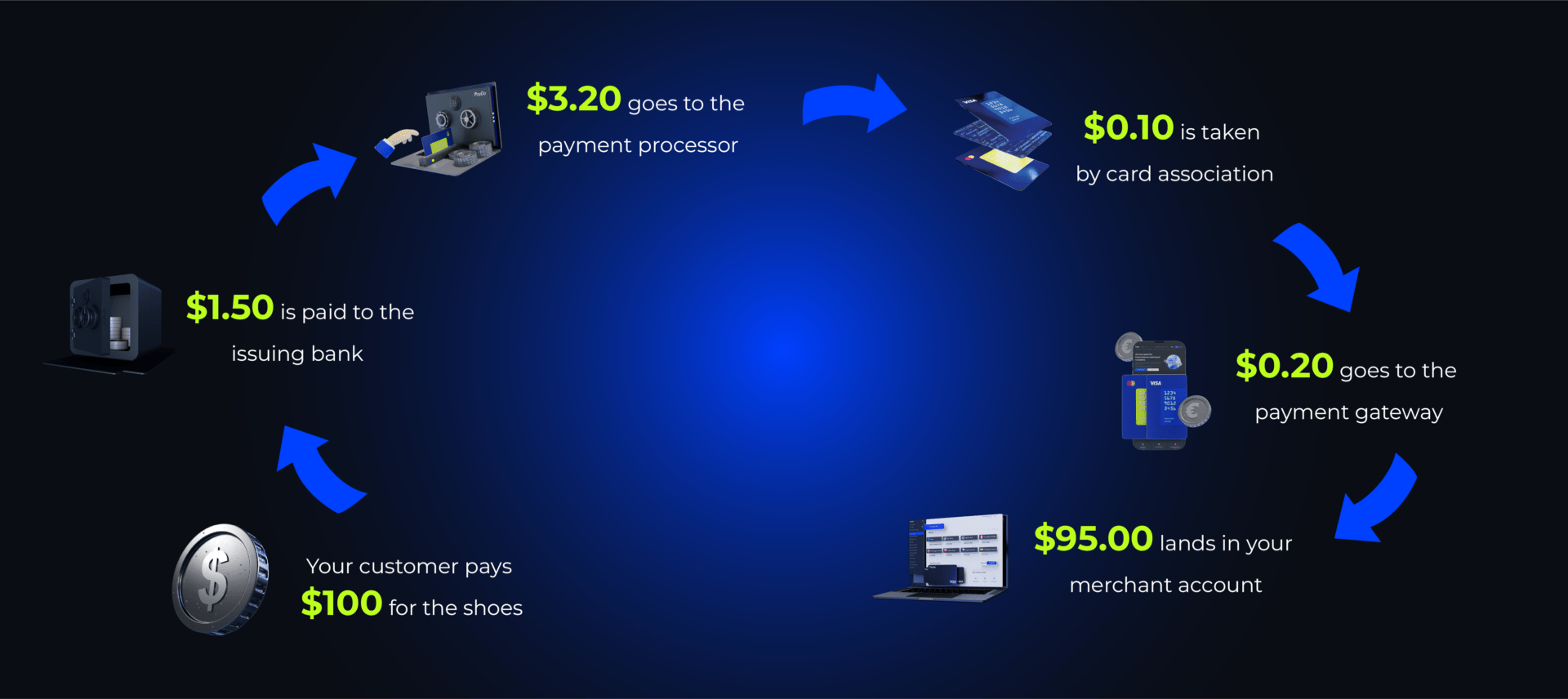
Imagine you’re a merchant selling shoes online. A customer happily pays you $100 at checkout. But, behind the scenes, there’s a journey for that money before it reaches your bank account:
First, the payment processor takes its cut, charging a percentage (let’s say 2.9%) plus a fixed fee ($0.30). So, from the $100, $3.20 goes to the payment processor.
Next, the card association, like Visa or Mastercard, takes a tiny piece, maybe 0.1%, which amounts to $0.10.
Then, the bank that issued the customer’s credit card wants its share, say 1.5%, taking $1.50.
Lastly, the payment gateway, ensuring secure transactions, charges a flat fee (let’s say $0.20).
When you add it all up, the total fees amount to $5.00. So, what initially seemed like $100 ends up being $95.00 that lands in your account.
These hidden fees, seemingly insignificant on an individual basis, can accumulate over a bank time, translating into a considerable amount. Understanding and addressing these hidden costs are essential steps towards making informed and cost-effective decisions in international payments and local money transfers.
Top 8 tips for finding the cheapest way to send money
In the quest for cost-effective money transfers, consider these eight essential tips that can help you maximise your financial resources.
1. Compare rates
Before initiating a money transfer, take the time to compare rates across different platforms. Various services may offer distinct $ exchange rate rates and fees, and choosing the right one can result in significant savings.
2. Understand the fees
Look into the details of fees associated with money transfers. Be aware of hidden charges, such as currency conversion fees and intermediary bank costs. This will help you make informed decisions when choosing the best payment method.
3. Use online services
Choose online money transfer services, often offering competitive exchange rates and user-friendly interfaces. Online platforms tend to have lower overhead costs than traditional methods, saving your business money.
4. Keep in mind currency conversion
Be mindful of currency conversion fees, as they can significantly impact the cost of international bank transactions. Choose services that offer favourable conversion rates or consider multi-currency accounts for better financial efficiency.
5. Track timing matters
Keep an eye on currency market trends and exchange rates. Timing your money to transfer -s strategically can result in better rates, saving your business money in the long run.
6. Use bulk transfers
If feasible, consolidate smaller transfers into larger, less frequent transactions. Many services offer better rates for bulk transfers, making it a cost-effective strategy for businesses.
For example, as a PayDo Business Account user, you can easily pay many payees in just minutes using our payment APIs. Our mass payout options include payments to other PayDo users, cards, and bank transfers. Learn more about mass payments.
7. Leverage promotions and discounts
Explore promotions, discounts, or loyalty programs offered by money transfer services. Utilising these incentives can lead to additional savings, especially for businesses engaged in frequent international money transfers.
8. Distinguish local vs. international transfers
Distinguish between local and international transfers, considering fees and rates may vary. Assess whether local options and international are more cost-effective for certain transactions, optimising your business’s financial resources.
By implementing a few of these tips, you can navigate the complex landscape of money transfers more effectively and identify the cheapest way to send money while optimising your financial resources.
Benefit from the cheapest way to send money – PayDo
At PayDo, we’ve combined the most essential financial services into one dashboard, allowing you to manage all your payments in one place. We understand that running a business can be challenging in today’s world, but we’re here to simplify it for you.
The PayDo Business account, PayDo Checkout (merchant services), and mass payments are seamlessly integrated into one application and governed by a single contract.
This comprehensive suite facilitates a swift initiation or expansion of your online business. It provides an efficient way to engage new customers by securely accepting payments worldwide.
Here is how it works. End-shoppers with a registered PayDo account can log in to the account and pay in 1 click with a linked card, PayDo wallet, or alternative payment methods.
If the client does not have an account, they can immediately create one from the checkout page, verify it in two step,s and complete the payment. Payment methods for the end shoppers are displayed according to your project settings and geolocation.
PayDo IBAN
You can sign up for a PayDo Business Account and pass verification in about 48 hours. As a result, you can request as many dedicated multicurenncy IBANs as you want. These come with:
SWIFT, SEPA, SEPA Instant, FPS and five more payment schemes for global transfers.
Access to 59+ currencies.
The chance to send/receive transfers from/to 170 destinations.
Transparent fees included.
PayDo Checkout
We ensure that our pricing plans are transparent and free of hidden fees. And you get the cheapest way to send money. PayDo’s fees take into consideration how you’re sending or receiving money, your user type (business or personal), and the location of your transactions. Pricing for Checkout transactions is tailored to payment methods and regions.
Additionally, we offer conversion rates based on current market conditions upon request. Explore our pricing plans to find the model that best suits your needs as a PayDo Business user.
FAQ
Find answers to common questions about international money transfers and business accounts.
How long does onboarding take?
Onboarding at PayDo typically takes 3 to 5 business days for business clients.
How are client funds protected?
Client funds are stored separately from operational funds in tier-1 European banks.
What are the mass payout options?
Mass payouts are available via API in EUR and GBP, initiated directly by the platform.
Conclusion
In a globalised world where financial transactions are necessary, finding the cheapest way to send money is paramount.
Hidden fees, often overlooked, can significantly impact the overall cost of transactions. Understanding and addressing these costs are crucial in making informed decisions for international and local money transfers.
To tap into the cheapest way to send money, consider these financial tips: compare rates, understand fees, use online services, be mindful of currency conversion, track timing, use bulk transfers, leverage promotions, and distinguish local vs. international transfers.
With transparent pricing plans tailored to your needs, PayDo ensures you can send money efficiently and cost-effectively, maximising your business’s financial resources. Create your PayDo Business account to explore opportunities for secure and borderless money transfers for your business goals.
The 30-Second Summary The fastest way for a digital goods platform to pay sellers in Europe and the UK is an instant transfer: SEPA Instant for euros and Faster Payments...
The 30-Second Summary Low transaction fees look like the obvious way to compare payment providers. Skin store owners start with the rate on the price sheet because it is the...
The 30-Second Summary A payment gateway for a game key store has one job: get buyers’ card payments approved and keep the account open as volume grows. For game key...
The 30-Second Summary SEPA Instant sends euros within the SEPA area in up to 10 seconds, 24/7. SWIFT works in almost any currency, but a transfer usually takes 1–2 business...
The 30-Second Summary In the fast-paced and ever-changing iGaming industry, what are the current best online casino payment methods? Today, we are taking a snapshot for 2025, when the iGaming...
The 30-Second Summary A Money Services Business (MSB) is a type of financial institution that offers various money-related services, such as money transfers, currency exchange, and check cashing. It is...
The 30-Second Summary Electronic Money Institutions (EMIs) and Money Services Businesses (MSBs) are becoming more and more popular. EMIs focus on digital transactions, providing electronic payment services and digital currency...
The 30-Second Summary Phishing remains a major cybersecurity threat, targeting individuals and businesses through fraudulent emails, messages, and websites. According to the Anti-Phishing Working Group (APWG), 3.8 million phishing attacks...
The 30-Second Summary As digital payments continue to grow, payment fraud remains a significant concern. According to Alloy’s 2026 State of Fraud Report, 67% of surveyed financial institutions and fintechs...
The 30-Second Summary A bank account ownership certificate, also known as a bank account certificate or proof of account ownership, is a document that says your bank account actually belongs...
The 30-Second Summary A Company Registration Number (CRN) is a code a business gets during incorporation. It acts as a distinct identifier for your company. It helps to differentiate your...
The 30-Second Summary Imagine each bank branch with its unique postal code — that’s what a branch code or sort code is in the financial world. It’s a set of...